T1660
Phishing (Mobile)
Smishing lure impersonating FRSC / FCT DRTS.
A Vue-and-Go phishing kit is impersonating Nigeria's road-safety and vehicle-registration services, relaying victims' card data and one-time passwords to a live operator console to authorise fraudulent international payments within minutes.
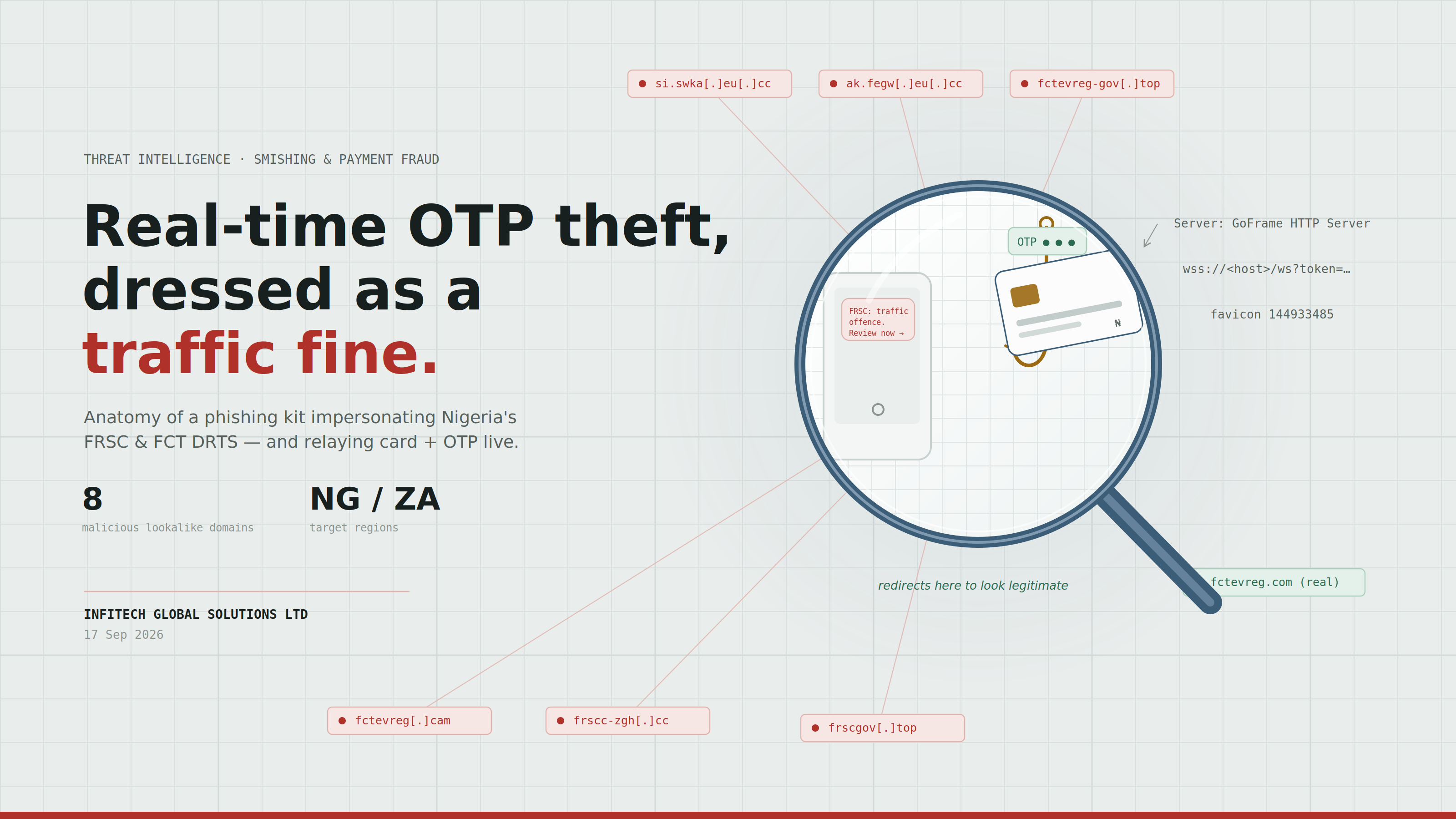
In mid-September 2026 the FRSC issued a public alert about fraudulent SMS messages telling recipients a new road-traffic offence had been recorded against them, and directing them to lookalike websites. The messages lean entirely on urgency:
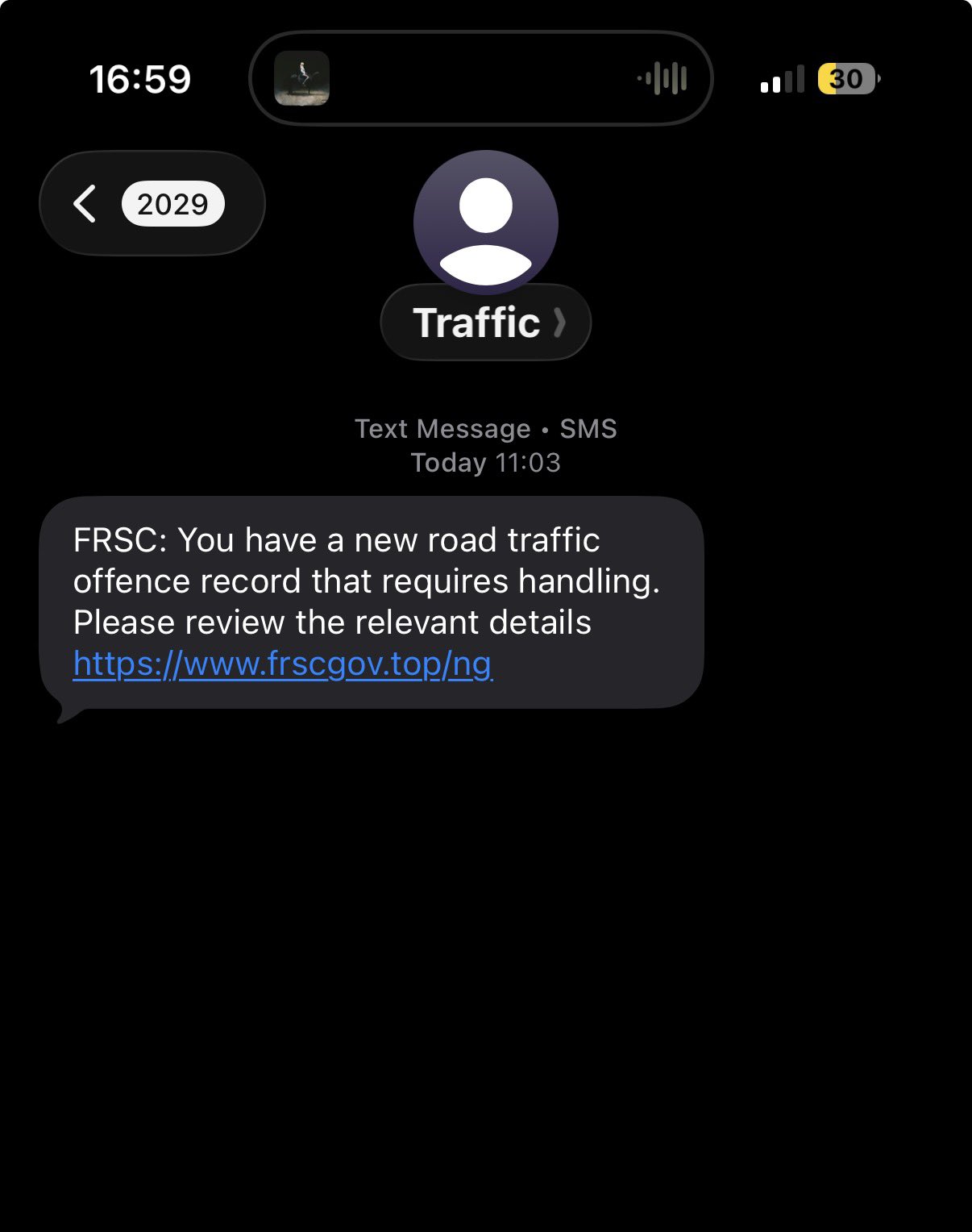
What makes this cluster worth a full teardown is not the lure — it is what sits behind the link. The kit turns a one-shot phishing page into an interactive, operator-driven fraud session capable of defeating one-time-password protection. The sections below reconstruct the victim journey, the kit's client and server components, and the infrastructure, then set out detection opportunities and indicators.
The full chain compresses a familiar smishing opening into a payment-fraud endgame. The victim never leaves what looks like a single official portal, while an operator watches every field arrive in real time.

Reconstructed from the client bundle's UI strings and captured traffic, the flow walks the victim from a plausible "lookup" into card and OTP entry, wrapped in reassurance screens designed to keep them waiting while the operator acts.
The waiting screens do the heavy lifting: strings such as Waiting for bank authorization…, Please go to your bank app to confirm the authorization, and The session is about to expire, please complete the verification now manufacture exactly the window an operator needs to submit the stolen card and consume the live OTP.
Client analysis (index-99e75bee.js, a 428 KB Vue/Vite bundle) plus intercepted HTTP/2 and WebSocket traffic reveal a two-layer server and a live operator channel sitting between victim and back office.
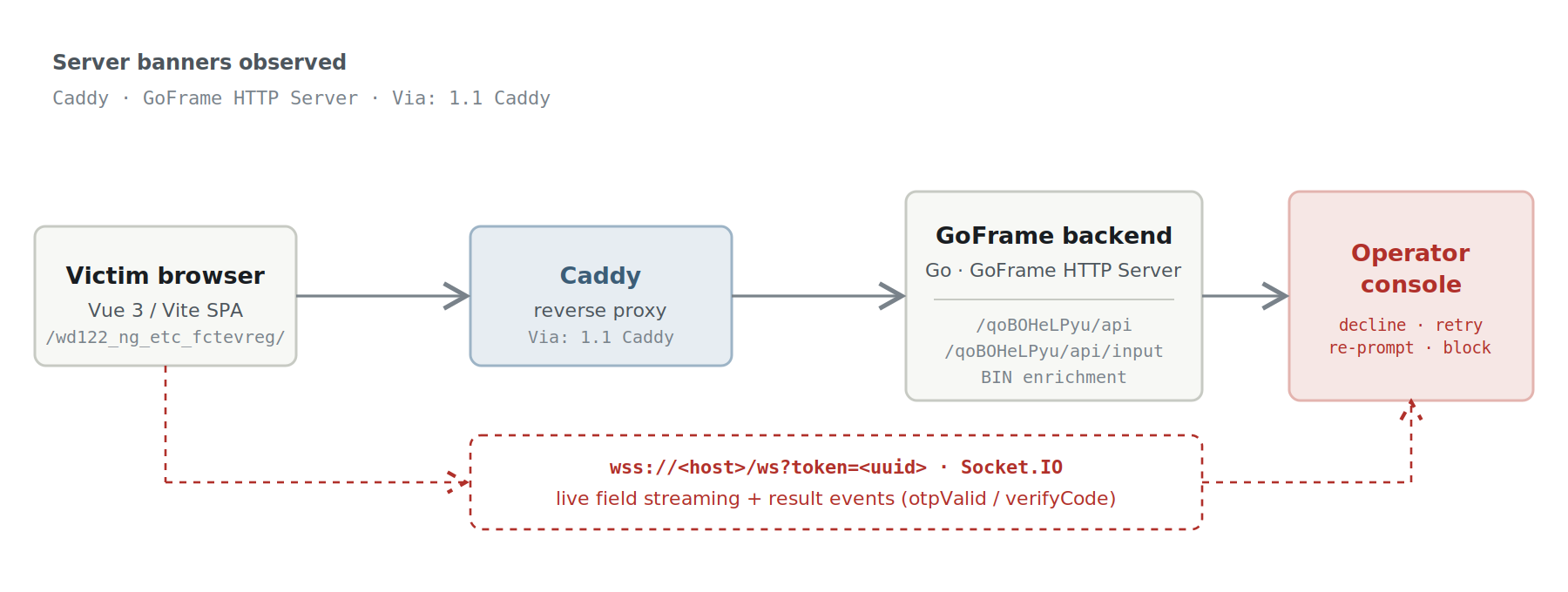
The SPA is a modern Vue 3 / Vite build loaded from the distinctive asset root /wd122_ng_etc_fctevreg/ — a string that folds together FRSC's 122 hotline, the ng country code, and the impersonated fctevreg brand. Each victim is issued a UUIDv4 session token carried redundantly as a cookie, a URL query parameter, and both X-Token and Token headers.
A Socket.IO WebSocket at wss://<host>/ws?token=<uuid> carries the session. Field values are pushed as the victim types: one capture showed an in-progress plate KJA-12BA streamed to /qoBOHeLPyu/api/input before the final submitted KJA-123BS. Result events (otpValid, customOtpValid, appValid, verifyCode) mark each stage for the operator.
The session-init response returns a custom configuration whose keys map directly to operator controls:
// session-init response → operator-controlled UI state
{
  "black_msg", "white_msg",          // block / allow banners
  "deny_c_msg", "deny_d_msg",        // credit / debit decline text
  "error_card_msg",                  // "try another card"
  "address_msg",                     // demand billing address
  "pay_amount", "pay_msg",          // set displayed charge
  "isBlock", "isFirst", "mode",     // session state
  "country": "NG"                     // deployment target
}
These let the operator, mid-session, reject a card and demand another, re-request the OTP under a fresh pretext, or ask for a billing address to satisfy a bank check — the toolkit of real-time authentication defeat.
Submitted cards are enriched by BIN before they even reach the operator's queue — issuer, scheme, type and country are resolved server-side (e.g. BIN 539983 → Guaranty Trust Bank, Nigeria, Mastercard debit), letting the operator triage the most valuable cards first.
Responses carry Server: GoFrame HTTP Server — a Go framework of Chinese origin — behind a Caddy front (Via: 1.1 Caddy). The randomised API base path /qoBOHeLPyu/ is per-deployment, a deliberate hedge against path-based scanning.
The campaign typosquats a genuine service. The malicious domains cluster around variants of the real fctevreg.com portal, while the kit itself redirects aborted sessions to the authentic site to appear credible and to shake off analysis sandboxes.
fctevreg.com, selfservice.fctevreg.com and ptms.fctevreg.com are the genuine FCT Directorate of Road Traffic Services portals, and frsc.gov.ng is the official FRSC site. They appear in the malicious page only because the kit impersonates them and redirects aborted sessions to the real site. Treating them as indicators would target legitimate public services and discredit the report.
Registration is deliberately opaque. The one lookalike with public WHOIS, fctevreg.cam, was registered on 15 September 2026 through Singapore-based registrar Gname.com with full privacy protection and a Hong Kong locality, on shared nameservers (a5.share-dns.com / b5.share-dns.net) that let the operators shuffle sites quickly. The .eu.cc hosts are third-level subdomains with no independent registration record at all.
Assessment: moderate confidence that this is a Chinese-language phishing-kit product run by a separate affiliate operator, consistent with the industrialised smishing-as-a-service ecosystem behind large "Smishing Triad"-style operations.
ABC 123 GP example ships alongside the Nigerian one) are hallmarks of a rented kit, not a bespoke build.country:"NG" config and FRSC-specific asset path indicate an affiliate deployment aimed at Nigeria; the ZA template shows the same kit is deployed elsewhere.Limits. Registrant data is privacy-protected and the infrastructure uses low-cost shared and subdomain services, so open-source personal attribution is not feasible. The strongest lead for law enforcement is the outbound money trail — a UAE merchant descriptor on the fraudulent card leg — reachable only through the bank and card scheme.
Because the operator relays a valid card and a live OTP in the same session, standard one-time-password protection is neutralised: the fraudulent authorisation carries a genuine bank OTP. In one publicly reported case a victim lost ~₦364,574 to an international card purchase with a Dubai (UAE) merchant descriptor minutes after entering details. The plate-entry step also manufactures a convincing "specific offence" even where the operators hold no prior data on the victim.
All hunts below are passive. Do not authenticate to, probe, or interact with the operator console or any exfil channel — that is unauthorised access, tips off the operator, and taints evidence. Document and refer.
# Shodan / Censys — server banner and shared favicon
http.headers.server:"GoFrame HTTP Server"
http.favicon.hash:144933485

# Content / URL string pivots (urlscan.io, passive DNS)
"wd122_ng_etc_fctevreg"   # distinctive asset root
"/qoBOHeLPyu/"            # randomised API base (per-deployment)
"index-99e75bee.js"       # Vite build hash — same build on other hosts

# Certificate transparency — MALICIOUS lookalikes only
crt.sh: swka.eu.cc, fegw.eu.cc, frscc-zgh.cc, fctevreg.cam,
        fctevregonline.click, fctevreg-gov.top, frscgov.top, frsac-govt.cc
# NB: do NOT action results for the legitimate fctevreg.com
.eu.cc subdomain service, the hosting provider behind the resolved IP, and the relevant registrars (Gname.com for fctevreg.cam). Exclude the legitimate domains.reportphishing@apwg.org), plus telco/browser blocklists.| Indicator | Type | Notes |
|---|---|---|
| si.swka[.]eu[.]cc | HOST | Observed landing host; path /com. |
| swka[.]eu[.]cc | DOMAIN | Parent of observed host. |
| ak.fegw[.]eu[.]cc | HOST | Additional landing host; new .eu.cc parent (fegw). |
| frscc-zgh[.]cc | DOMAIN | FRSC lookalike (frscc) on .cc. |
| fctevreg[.]cam | DOMAIN | Reg. 2026-09-15, Gname.com (SG), privacy-protected. |
| fctevregonline[.]click | DOMAIN | Lookalike. |
| fctevreg-gov[.]top | DOMAIN | Lookalike. |
| frscgov[.]top | DOMAIN | Named in FRSC alert. |
| frsac-govt[.]cc | DOMAIN | Lookalike. |
| a5.share-dns.com · b5.share-dns.net | NS | Shared nameservers (fctevreg.cam). |
| Indicator | Type | Notes |
|---|---|---|
| /wd122_ng_etc_fctevreg/ | PATH | Distinctive asset root; best hunting string. |
| /qoBOHeLPyu/api · /api/input | PATH | Randomised API base + live-input endpoint. |
| /ws?token=<uuid> | WS | Socket.IO control channel. |
| Server: GoFrame HTTP Server | BANNER | Backend fingerprint. |
| Server: Caddy · Via: 1.1 Caddy | BANNER | Front proxy. |
| 144933485 | FAVICON | murmur3 hash — http.favicon.hash:. |
| index-99e75bee.js | BUILD | Vite bundle hash. |
| index-789aed68.css · index-C6qrI_xe.css | BUILD | CSS bundle hashes. |
| f.woff2 · t.woff2 · z.woff2 | ASSET | Fonts under the asset root. |
| otpValid · customOtpValid · appValid · verifyCode | PROTO | Result-event names. |
| Domain | Status | Owner |
|---|---|---|
| frsc.gov.ng | LEGIT | Federal Road Safety Corps (official). |
| fctevreg.com · www.fctevreg.com | LEGIT | FCT DRTS (impersonation victim). |
| selfservice.fctevreg.com · ptms.fctevreg.com | LEGIT | FCT DRTS e-registration / PTMS portals. |
| Indicator | Value |
|---|---|
| Example fraudulent debit | ~₦364,574.36 |
| Merchant descriptor | "Web Pur, SERIOUS FIX MACHINERY, Dubai" (UAE) |
| Example targeted BIN | 539983 — GTBank NG, Mastercard debit |